
How Long Do Strain Gauges Actually Last? The Real Answer Every Infra Engineer Needs to Know
Ever installed a strain gauge sensor on a bridge and secretly wondered, “Okay, but how long before this thing ghosts me?”
You’re not alone. With over 623,000 bridges across the U.S. and an average age pushing 47 years old (according to the latest ASCE Infrastructure Report Card), knowing the true service life of your strain monitoring systems isn’t just academic, it’s mission-critical. Especially when the nation’s backlog for bridge repairs sits at a staggering $191 billion.
At Resensys, we live and breathe structural health monitoring every day. Let’s cut through the fluff and talk about how long strain gauge sensors actually last and why modern wireless strain monitoring systems are quietly becoming the heroes of long-term asset management.
What Is a Strain Gauge Sensor?
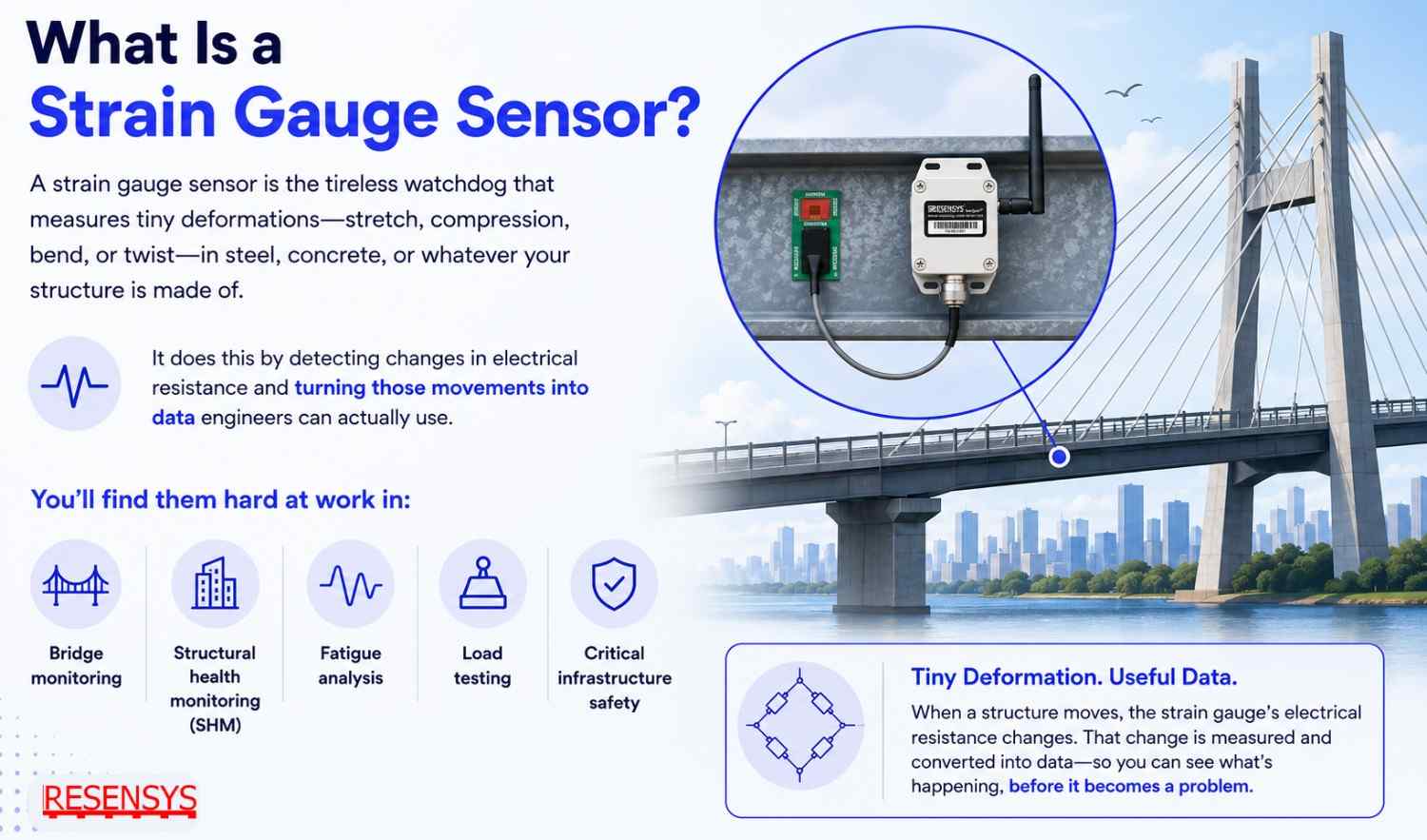
A strain gauge sensor is the tireless watchdog that measures tiny deformations – stretch, compression, bend, or twist – in steel, concrete, or whatever your structure is made of. It does this by detecting changes in electrical resistance and turning those movements into data engineers can actually use.
You’ll find them hard at work in:
- Bridge monitoring
- Structural health monitoring (SHM)
- Fatigue analysis
- Load testing
- Critical infrastructure safety
They’re the early-warning system that tells you something’s shifting before it becomes a very expensive (or dangerous) surprise.
If you’re still figuring out the basics, check out our post on strain gauge transducers.
So… What’s the Typical Lifespan of a Strain Gauge?
Here’s the breakdown:
| Application Type | Estimated Service Life |
| Temporary testing | Days to months |
| Industrial monitoring | 2–5 years |
| Long-term infrastructure | 10+ years |
| Advanced wireless SHM systems | Often 10–20 years |
In permanent bridge and dam installations, traditional wired systems often failed much sooner than expected. Today’s wireless strain monitoring systems? They’re built for the long haul.
What Kills a Strain Gauge (and How to Fight Back)
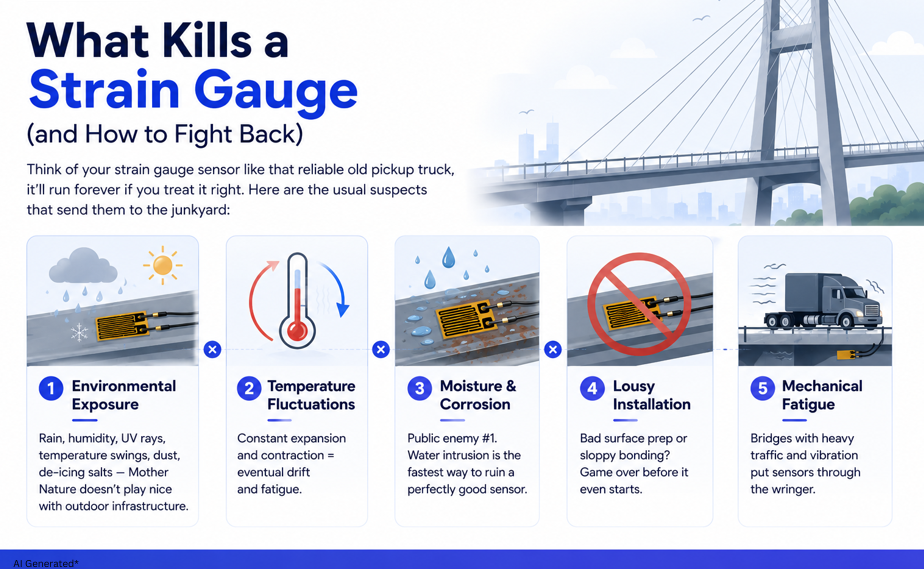
Think of your strain gauge sensor like that reliable old pickup truck, it’ll run forever if you treat it right. Here are the usual suspects that send them to the junkyard:
- Environmental Exposure: Rain, humidity, UV rays, temperature swings, dust, de-icing salts – Mother Nature doesn’t play nice with outdoor infrastructure.
- Temperature Fluctuations: Constant expansion and contraction = eventual drift and fatigue.
- Moisture & Corrosion: Public enemy #1. Water intrusion is the fastest way to ruin a perfectly good sensor.
- Lousy Installation: Bad surface prep or sloppy bonding? Game over before it even starts.
- Mechanical Fatigue: Bridges with heavy traffic and vibration put sensors through the wringer.
Why Wireless Strain Monitoring Systems Last Longer (and Why We’re Big Fans)
Here’s where things get exciting.
Traditional wired systems come with a laundry list of headaches: cable degradation, connection failures, lightning vulnerability, and the nightmare of running wires across massive structures. No thanks.
Wireless strain monitoring systems flip the script:
- No cabling drama
- Way lower maintenance
- Long-life, low-power batteries (we’re talking 10+ years on a single coin-cell in many cases)
- Remote diagnostics so you catch issues before they become problems
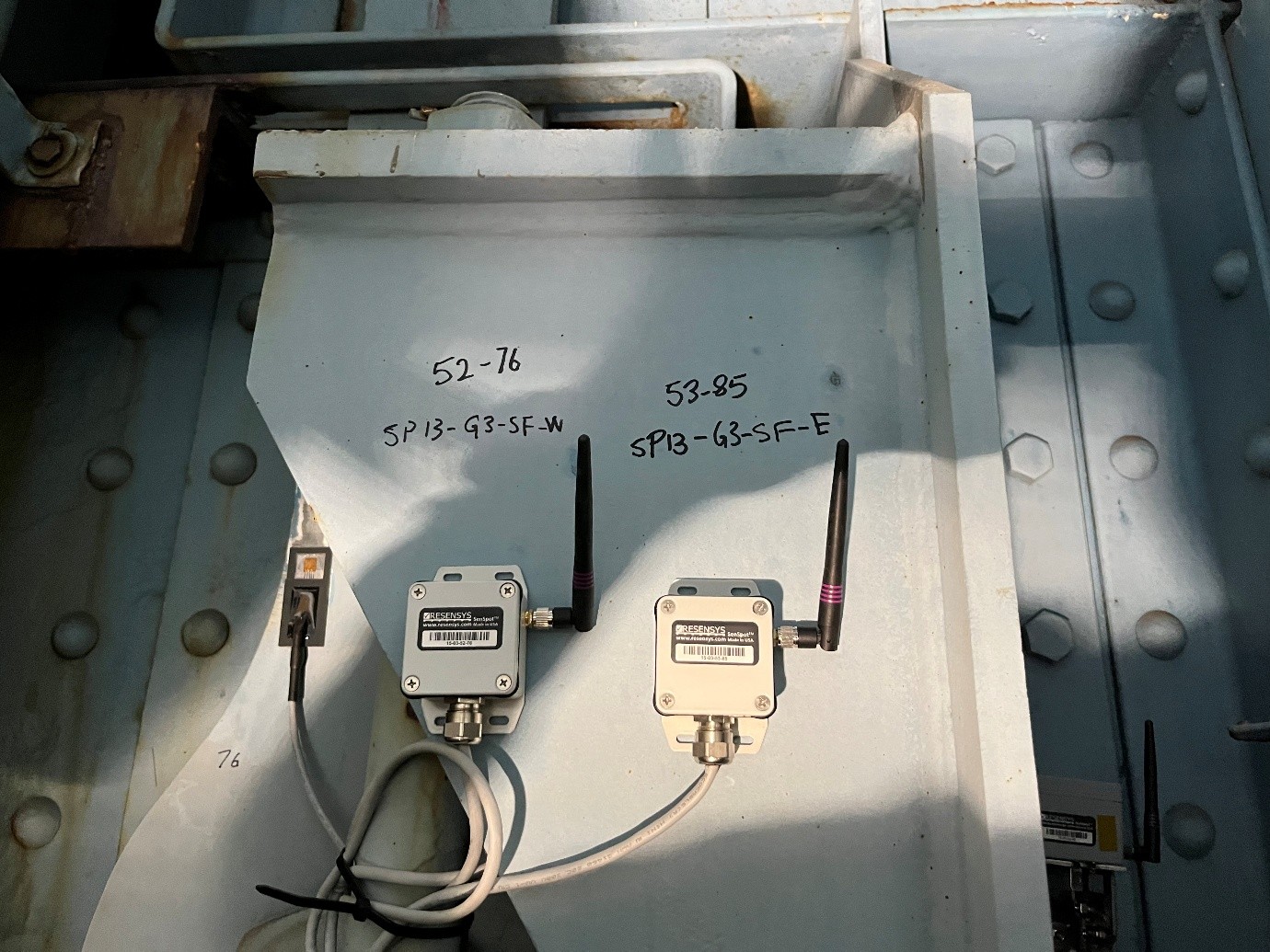
At Resensys, our SenSpot™ sensors were purpose-built for exactly this reality. Tiny, rugged, insanely energy-efficient, and designed to sit there quietly delivering high-resolution strain, tilt, displacement, and vibration data for years with almost zero babysitting.
Signs Your Strain Gauge Is on Its Last Leg
Keep an eye out for:
- Signal drift
- Inconsistent or noisy readings
- Dropping sensitivity
- Visible corrosion or physical damage
- Dropped wireless communication
Routine calibration and remote monitoring catch most of these before they bite you.
How Resensys Makes Long-Term Strain Monitoring Actually Practical
We didn’t just build another sensor, we built a system that respects your time, your budget, and the brutal realities of field deployment.
Our wireless strain gauge sensors give you:
- High-resolution, real-time data
- Easy, non-disruptive installation
- 10+ year battery life
- Cloud-based SenScope™ analytics so you can make decisions from your desk (or the cab of your truck)
Engineers and DOT teams love them because they finally let you move from reactive “hope and pray” inspections to true predictive maintenance.
Best Practices to Squeeze Every Last Year Out of Your Sensors
Want maximum lifespan? Do these:
- Nail the surface prep and bonding during install
- Use proper protective coatings and sealing
- Choose wireless low-power systems from the start
- Set up continuous remote monitoring and alerts
- Calibrate and check performance on a smart schedule
The Future Looks Wireless (and a Whole Lot Smarter)
We’re heading into an era of AI-powered analytics, digital twins, and autonomous monitoring. The bridges of tomorrow won’t just be stronger – they’ll be smarter, with structural health monitoring systems that give you answers instead of just raw data.
Bottom Line
The service life of a strain gauge sensor isn’t set in stone – it’s shaped by environment, installation, and technology choices. Traditional setups often fade after a few years in the wild. But modern wireless strain monitoring systems like Resensys SenSpot™ are rewriting the rules, delivering reliable performance for up to 20 years while dramatically cutting maintenance headaches.
If you’re responsible for keeping America’s infrastructure standing strong, don’t settle for sensors that quit on you. Give your structures the long-life monitoring they deserve with Resensys.
Ready to talk about upgrading your structural health monitoring game? Drop us a note at info@resensys.com or explore our wireless products here.

About Author

Matt
-
 Resensys Wireless systems used to monitor I-40 over Mississippi River Bridge
On May 12, 2021 a crack found in the I-40 bridge connecting
-
 Flood Warning Systems and Real-Time Monitoring: A Smarter Approach to Mitigating Risk
Floods are one of the most devastating natural disasters, with the potential